Report Statements (Tense Backshift)
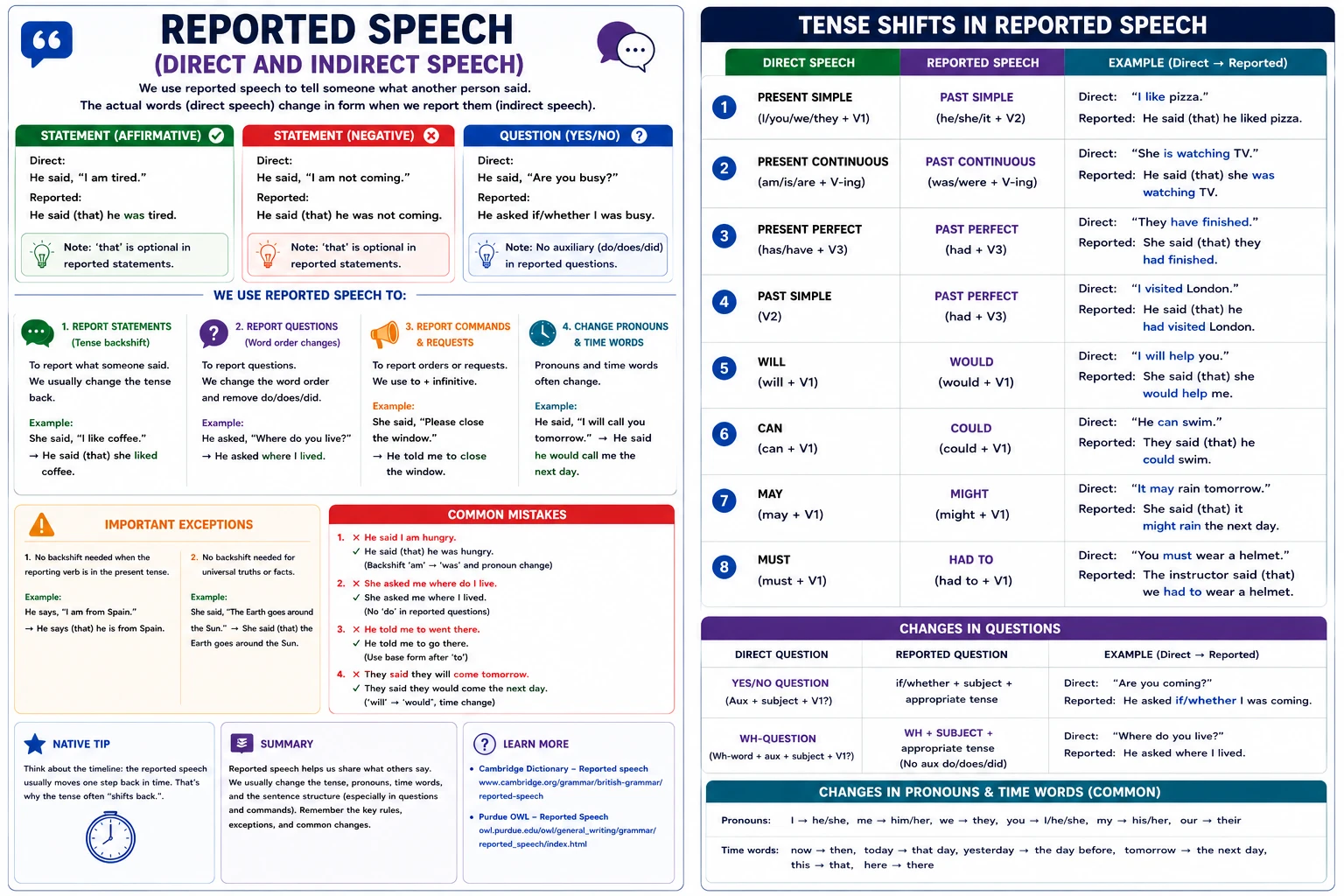
To report what someone said, we usually change the tense back one step.
- — She said, "I like coffee." → She said (that) she liked coffee.
Reported Speech
Master reported speech transformations — tense backshift, pronoun changes, and reporting verbs.
Direct and Indirect Speech on Grammartier spans A2–C2 levels, with 42 interactive lessons including Reporting Statements, Reporting Questions and Reporting Yes/No Questions — each with clear explanations, real examples, and a quiz you can score instantly.
Reported speech (indirect speech) lets you tell someone what another person said, without quoting their exact words. The tense, pronouns, and time words usually shift back — that's called backshift. This lesson breaks down statements, questions, and commands, plus the mistakes that trip up even confident learners.
Subject + said (that) + reported clause
Subject + said (that) + subject + negative verb
Subject + asked + if/whether + subject + past-tense verb
Report Statements (Tense Backshift)
To report what someone said, we usually change the tense back one step.
Report Questions (Word Order Changes)
To report questions, we change the word order and remove do/does/did. Yes/no questions use if/whether; wh-questions keep the question word with no auxiliary.
Report Commands & Requests
To report orders or requests, we use to + infinitive, usually with told, asked, ordered, advised, or a similar reporting verb (not said).
Change Pronouns & Time Words
Pronouns and time words often change to match the new speaker and time perspective.
No backshift when the reporting verb is present tense
If the reporting verb (says, tells) is in the present tense, the tense doesn't need to shift back: He says, "I am from Spain." → He says (that) he is from Spain.
No backshift for universal truths or facts
Facts that are still true don't need backshift: She said, "The Earth goes around the Sun." → She said (that) the Earth goes around the Sun.
He said I am hungry.
He said (that) he was hungry.
Backshift am → was, and change the pronoun I → he to match the reported speaker.
She asked me where do I live.
She asked me where I lived.
Don't use do/does/did in reported questions — the word order changes to subject + verb, with no auxiliary.
He told me to went there.
He told me to go there.
After to in a reported command, always use the base form of the verb, not the past tense.
They said they will come tomorrow.
They said they would come the next day.
Backshift will → would, and change the time word tomorrow → the next day.
How each direct-speech tense shifts back when reported.
| Feature | Direct speech | Reported speech | Example |
|---|---|---|---|
| Present simple | Past simple | Direct: "I like pizza." → Reported: He said (that) he liked pizza. | |
| Present continuous | Past continuous | Direct: "She is watching TV." → Reported: He said (that) she was watching TV. | |
| Present perfect | Past perfect | Direct: "They have finished." → Reported: She said (that) they had finished. | |
| Past simple | Past perfect | Direct: "I visited London." → Reported: He said (that) he had visited London. | |
| will | would | Direct: "I will help you." → Reported: She said (that) she would help me. | |
| can / may / must | could / might / had to | Direct: "He can swim." → Reported: They said (that) he could swim. |
Reported speech helps us share what others said, usually shifting the tense, pronouns, and time words back one step when necessary. Statements use (that) and backshift the tense. Yes/no questions use if/whether; wh-questions keep the question word with no auxiliary and no that. Commands and requests use told + to + infinitive. No backshift is needed when the reporting verb is present tense or the original statement is a universal truth.
Further reading: Cambridge Dictionary — Reported speech, Purdue OWL — Reported Speech
It's how we tell someone what another person said, without quoting their exact words. Direct: He said, "I am tired." Reported: He said (that) he was tired.
No — skip the backshift when the reporting verb is present tense (He says he is tired) or when reporting a universal truth or fact that's still true.
Use if or whether, not that: He asked, "Are you coming?" → He asked if/whether I was coming.
Keep the question word, remove do/does/did, and use statement word order: He asked, "Where do you live?" → He asked where I lived.
Use told (not said) + to + infinitive: He said, "Please close the window." → He told me to close the window.
Convert direct statements into reported speech using that-clauses, tense backshift, and pronoun changes.
Transform direct questions into indirect reported questions — word order changes, no auxiliary inversion, that-clauses.
Report yes/no questions using whether or if, with correct word order and no question mark.
Report wh-questions using the original question word and affirmative word order: She asked where I lived.
Report commands and instructions using tell/order/instruct + object + to-infinitive with tense and pronoun changes.
Report polite requests using ask/request + object + to-infinitive and recognise the difference from commands.
Report suggestions using suggest + -ing, suggest + that-clause, and other reporting verb patterns for recommendations.
Report advice using advise, recommend, urge + object + to-infinitive or advise + that-clause patterns.
Report warnings using warn + object + not to-infinitive and warn + that-clause — essential for academic and formal writing.
Report invitations using invite/ask + object + to-infinitive and understand how to soften or make invitations more formal.
Master the system of tense changes in reported speech — when backshift applies and when it can be avoided.
Learn the complete backshift table: present → past, past → past perfect, will → would, can → could, and more.
Report present simple and present continuous statements with correct backshift to past simple and past continuous.
Report past simple and past continuous statements with backshift to past perfect and past perfect continuous.
Report will, going to, and present continuous future by changing to would, was/were going to, and was/were + -ing.
Report modal verbs correctly: will → would, can → could, may → might, must → had to, shall → should.
Report present perfect and past perfect tenses — understanding when backshift applies and when it does not change.
Convert time expressions: now → then, today → that day, tomorrow → the next day, last year → the previous year.
Convert place expressions: here → there, this room → that room, come → go — with practical examples from real contexts.
Change pronouns correctly: I → he/she, we → they, my → his/her — one of the most common sources of error in reported speech.
Convert this → that, these → those, and understand how demonstratives shift perspective in indirect speech.
Learn the most common reporting verbs — say, tell, ask, explain, answer — and their grammatical patterns.
Use a wide range of reporting verbs — argue, insist, deny, acknowledge, imply — with correct patterns.
Use advise, suggest, recommend, urge, encourage + correct patterns to report advice and suggestions accurately.
Use claim, argue, believe, maintain, assert, contend + that-clause to attribute opinions and arguments to specific people.
Use academic reporting verbs — state, argue, demonstrate, highlight, suggest — correctly in essays, reports, and dissertations.
Report complex sentences that mix tenses and understand when backshift is optional or when the meaning would change.
Report informal conversations naturally — choosing the right reporting verb, tense, and register for everyday spoken English.
Use reported speech in journalistic writing — attribution, reporting verbs, and the conventions of news-style indirect speech.
Integrate sources correctly in academic writing using reported speech — paraphrase, summary, and attribution with appropriate verbs.
Choose the appropriate register when reporting speech — formal structures for academic/business contexts vs natural structures in conversation.
Use passive reported speech — It is said that, He is believed to, They are reported to have — in formal and journalistic English.
Report conditional and hypothetical statements accurately — managing if-clauses, would, could, might in reported contexts.
Identify and correct the most frequent reported speech errors — wrong tense, wrong pronoun, incorrect word order in reported questions.
Fix the most common tense errors: forgetting backshift, wrong perfect form, incorrect modal change.
Correct pronoun mistakes: keeping I/we/you unchanged instead of shifting to he/she/they/I appropriately.
Avoid errors with reporting verbs — wrong pattern after say/tell, incorrect preposition, wrong infinitive or gerund form.
Report everyday conversations informally and naturally — the way native speakers actually use reported speech in daily life.
Use natural spoken reporting patterns — dropping that, optional tense changes, discourse markers like apparently and supposedly.
Report phone call content accurately — who said what, key information given, and appropriate use of say, tell, ask, and explain.
Use indirect questions to ask politely: Could you tell me…? Do you know…? I was wondering whether… — and report what someone asked.
Use the most formal reporting and attribution structures found in academic, legal, and journalistic writing.