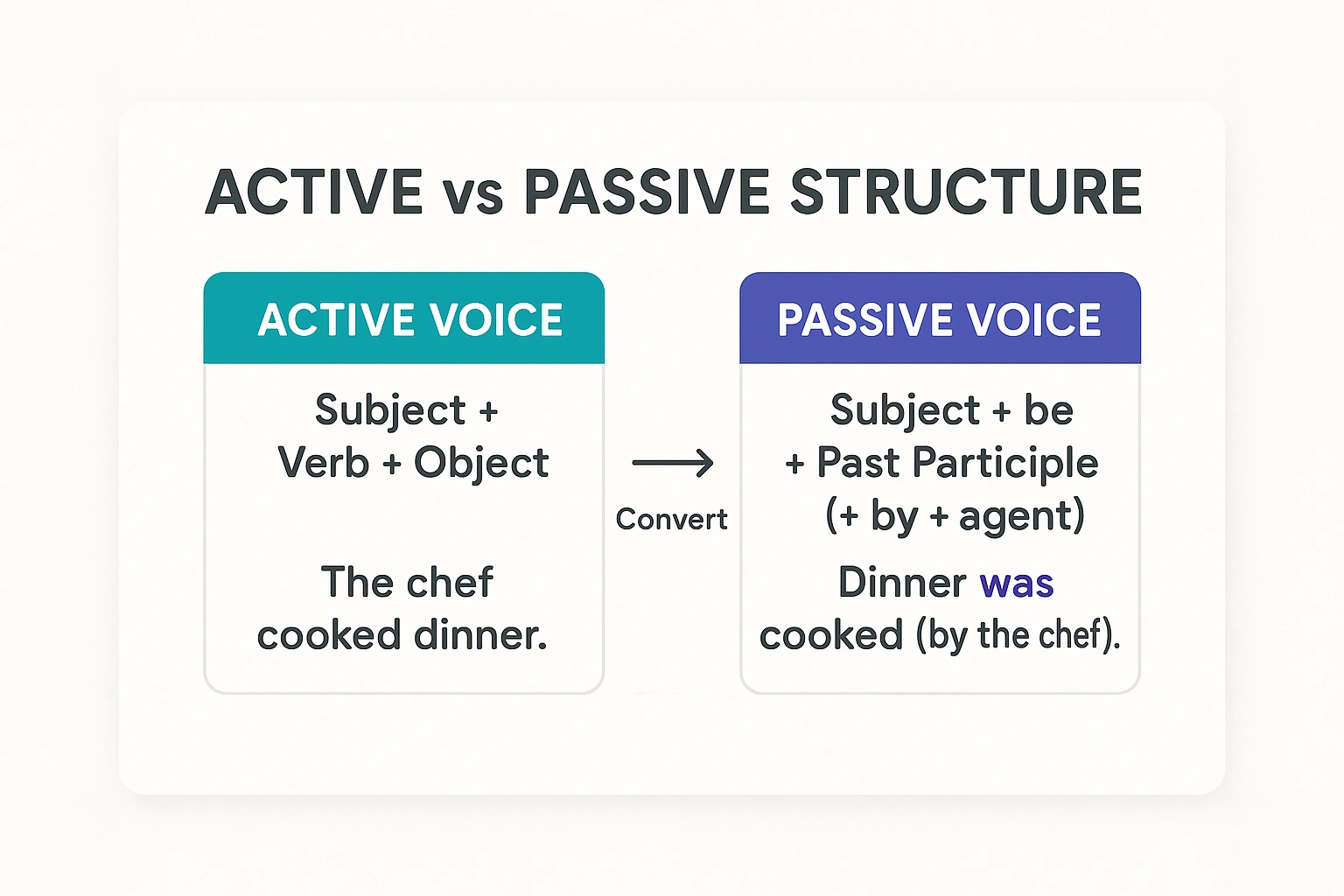
Master voice transformations — when and how to use active and passive constructions.
Active and Passive Voice on Grammartier spans B1–C1 levels, with 18 interactive lessons including Active Voice, Passive Voice and Changing Active to Passive — each with clear explanations, real examples, and a quiz you can score instantly.
31
Topics in this category
18
Lessons available
A1 → C2
CEFR coverage
Active and passive voice are two ways of structuring the same information — the difference is who (or what) you put in the subject position. The active voice puts the doer first and is direct, while the passive voice puts the action or receiver first and is more formal. This page covers when to use each one, how to form the passive across all tenses, and the mistakes that trip up even confident learners. Choose any sub-topic below to dive into a full interactive quiz.
By the end of this lesson, you will be able to:
Form the passive voice correctly across all tenses — present, past, future, perfect, and continuous
Convert any active sentence to passive using the three-step swap-pivot-form process
Decide when to use active vs passive based on tone, formality, and who (or what) you want to emphasise
Recognise and avoid the 4 most common passive-voice mistakes
Structure & Form
Active and passive voice formulas side by side.
Positive
Subject + be + past participle (+ by + agent)
Negative
Subject + be + not + past participle (+ by + agent)
Question
Be + subject + past participle (+ by + agent)?
How It's Used
When to Use Active Voice
Direct, personal, concise — the standard choice for most writing. The subject performs the action clearly.
— Research has shown that active voice makes writing more engaging.
— Shakespeare wrote Hamlet in the early 1600s.
— The manager approved the proposal yesterday.
When to Use Passive Voice
Use when the action or receiver is more important than the doer, when the doer is unknown, or in formal/academic contexts.
— The patient was admitted at 3am. (doer unknown or unimportant)
— It is believed that the manuscript dates from the 12th century.
— VAT should be paid within 30 days.
Agent: To Include or Omit?
Include the agent (by + noun) when the doer is important or surprising. Omit it when the doer is obvious, unknown, or irrelevant.
— Include: The Mona Lisa was painted by Leonardo da Vinci.
— Omit: A new hospital will be built next year.
— Omit: My phone was stolen. (unknown agent)
Passive in Academic & Scientific Writing
The passive is standard in scientific writing to emphasise the process, not the researcher. Also common in news and legal language.
— The mixture was heated to 100°C and then cooled rapidly.
— It is recommended that all data be verified before publication.
— Ten people were injured in the accident.
Exceptions to Watch For
Not all verbs can become passive
Intransitive verbs — verbs that don't take an object (arrive, sleep, cry, happen, fall) — cannot be made passive because there's no receiver of the action. You can say She arrived late but not Late was arrived by her.
Stative passives describe a state, not an action
Stative passives (subject + be + past participle as adjective) describe a resulting state. Compare: The window was broken (dynamic — someone broke it) vs. The window is broken (stative — describing its current state). Stative passives usually leave out the by-phrase because the agent isn't the point — but it's not a hard rule: The house is surrounded by trees is a stative passive that does include one.
Common Mistakes
The book was wrote by Mark Twain.
The book was written by Mark Twain.
The passive always needs the past participle, not the past simple. Write → wrote (past simple) → written (past participle).
The problem is being fix right now.
The problem is being fixed right now.
The past participle of fix is fixed, not fix. Don't drop the -ed in regular passive forms.
New regulations has been introduced.
New regulations have been introduced.
The auxiliary verb (have/has/had) must agree with the passive subject. Regulations (plural) → have been, not has been.
The meeting will hold next week.
The meeting will be held next week.
Hold is transitive here — the meeting doesn't hold itself, it is held by someone. This is a voice-choice error, not a verb-form error.
Active vs Passive Across Tenses
The passive always follows the same core pattern — be + past participle — but be takes a different form depending on the tense. These 6 rows cover the most common passive structures in modern English, from simple tenses to non-finite forms.
Feature
Active
Passive
Tense / Structure
Key Difference
Present & Past Simple
She writes the report.
The report is written (by her).
Present & Past Simple
be (is/are/was/were) + past participle
Present & Past Continuous
She is writing the report.
The report is being written (by her).
Present & Past Continuous
be (is/are/was/were) + being + past participle
Present & Past Perfect
She has written the report.
The report has been written (by her).
Present & Past Perfect
have/has/had + been + past participle
Future (will)
She will write the report.
The report will be written (by her).
Future (will)
will + be + past participle
Modal Verbs
She must write the report.
The report must be written (by her).
Modal Verbs
modal + be + past participle
Passive Infinitive
Someone needs to finish the report.
The report needs to be finished.
Passive Infinitive
(modal/verb) + to be + past participle
Summary
Active voice (subject performs the action) is direct and personal — use it for most writing. Passive voice (subject receives the action) is formed with be + past participle — use it when the doer is unknown, unimportant, or when you want to emphasise the action or receiver. The passive can be formed in any tense by conjugating be to match the tense and adding the past participle. Intransitive verbs (no object) cannot become passive. For everyday writing, prefer the active voice; for academic, scientific, and formal writing, the passive has an essential place.
What's the difference between active and passive voice?
In the active voice, the subject performs the action (The chef cooked dinner). In the passive voice, the subject receives the action (Dinner was cooked by the chef). The core information is the same — the difference is which element you put in the subject position.
How do I convert an active sentence to passive?
Three steps: (1) Move the object to the subject position. (2) Conjugate the verb be to match the original tense. (3) Add the past participle of the main verb, plus by + original subject if you want to include the agent. Example: Active The chef cooks dinner → Passive Dinner is cooked (by the chef).
When should I use the passive voice?
Use the passive when: the doer is unknown (My phone was stolen), the doer is obvious (VAT must be paid), the action or receiver is more important (Ten people were injured), or in formal/academic writing (The mixture was heated). In most other situations, the active voice is clearer and more direct.
Can every verb be used in the passive voice?
No — only transitive verbs (verbs that take an object) can become passive. Intransitive verbs like arrive, sleep, happen, take place, and fall do not have objects, so they cannot form a passive. You cannot say Late was arrived by her or A nap was slept by the cat.
What's the difference between 'was broken' and 'has been broken'?
Both are passive, but the tense changes the meaning. Was broken (past simple passive) describes a completed action at a specific past time: The window was broken yesterday. Has been broken (present perfect passive) connects a past action to the present — the result still matters: The window has been broken for weeks (and it's still broken now).
Is the passive voice bad writing?
No — the passive is not grammatically wrong, and it's essential in certain contexts. However, overusing the passive can make writing sound evasive, wordy, or bureaucratic. The active voice is generally preferred for clarity and engagement. The key is knowing when each voice is appropriate rather than avoiding one entirely.