Zero Conditional — General Truths
If + present simple, + present simple. Used for facts and things that are always true.
- — If you heat ice, it melts.
- — If you mix red and blue, you get purple.
If Structures
Understand zero, first, second, third, and mixed conditional structures with real-world examples.
Conditionals on Grammartier spans A2–C2 levels, with 11 interactive lessons including Zero Conditional, Unless and Conditionals and First Conditional — each with clear explanations, real examples, and a quiz you can score instantly.
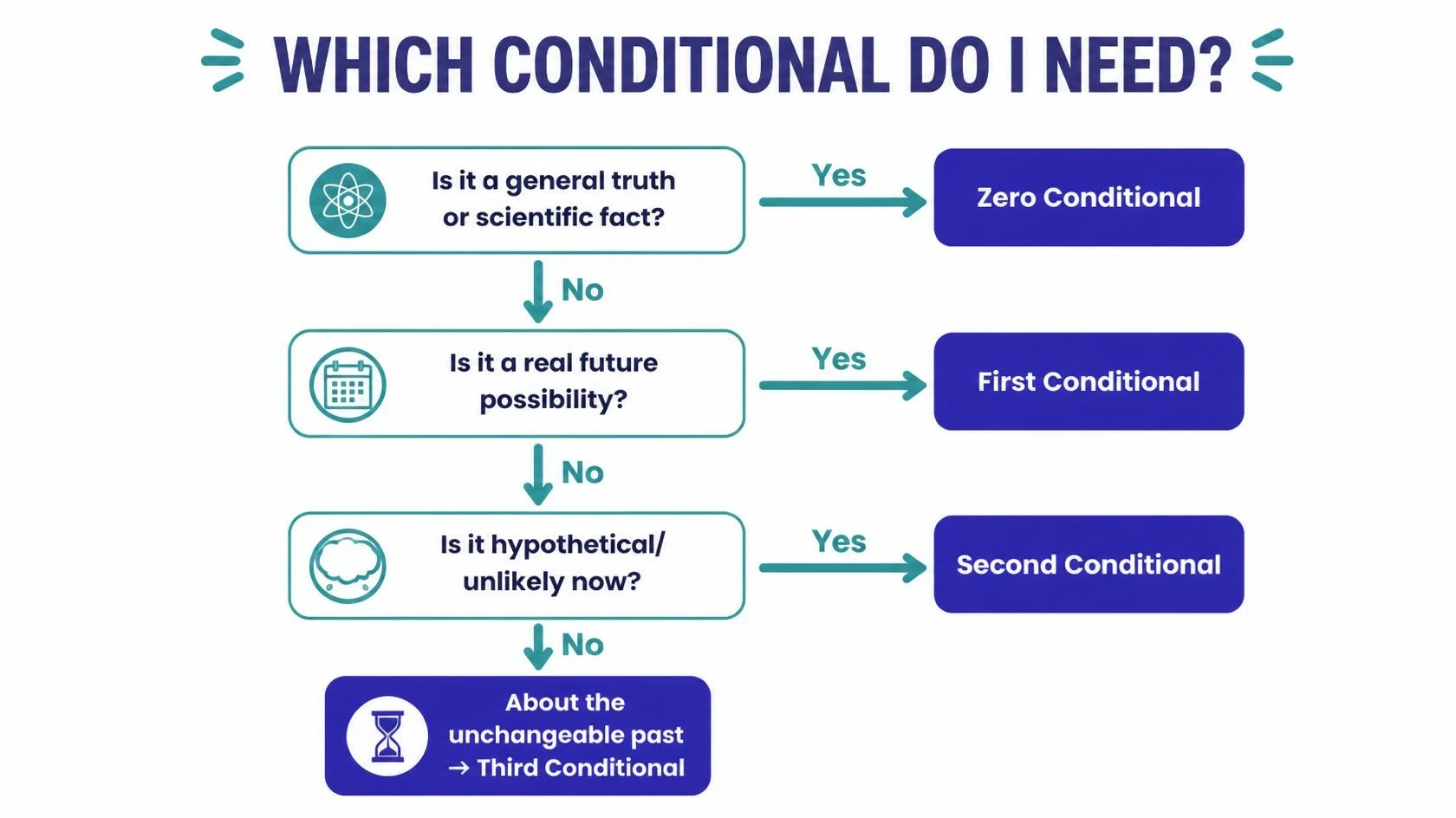
Conditionals are "if" sentences — they describe a condition and its result. English has four main conditional types, plus mixed conditionals that combine different time frames, and choosing the right one comes down to one question: how real or likely is the situation? This page walks through all four types side by side, gives you a simple way to decide which one you need, and links down to a full interactive quiz for each.
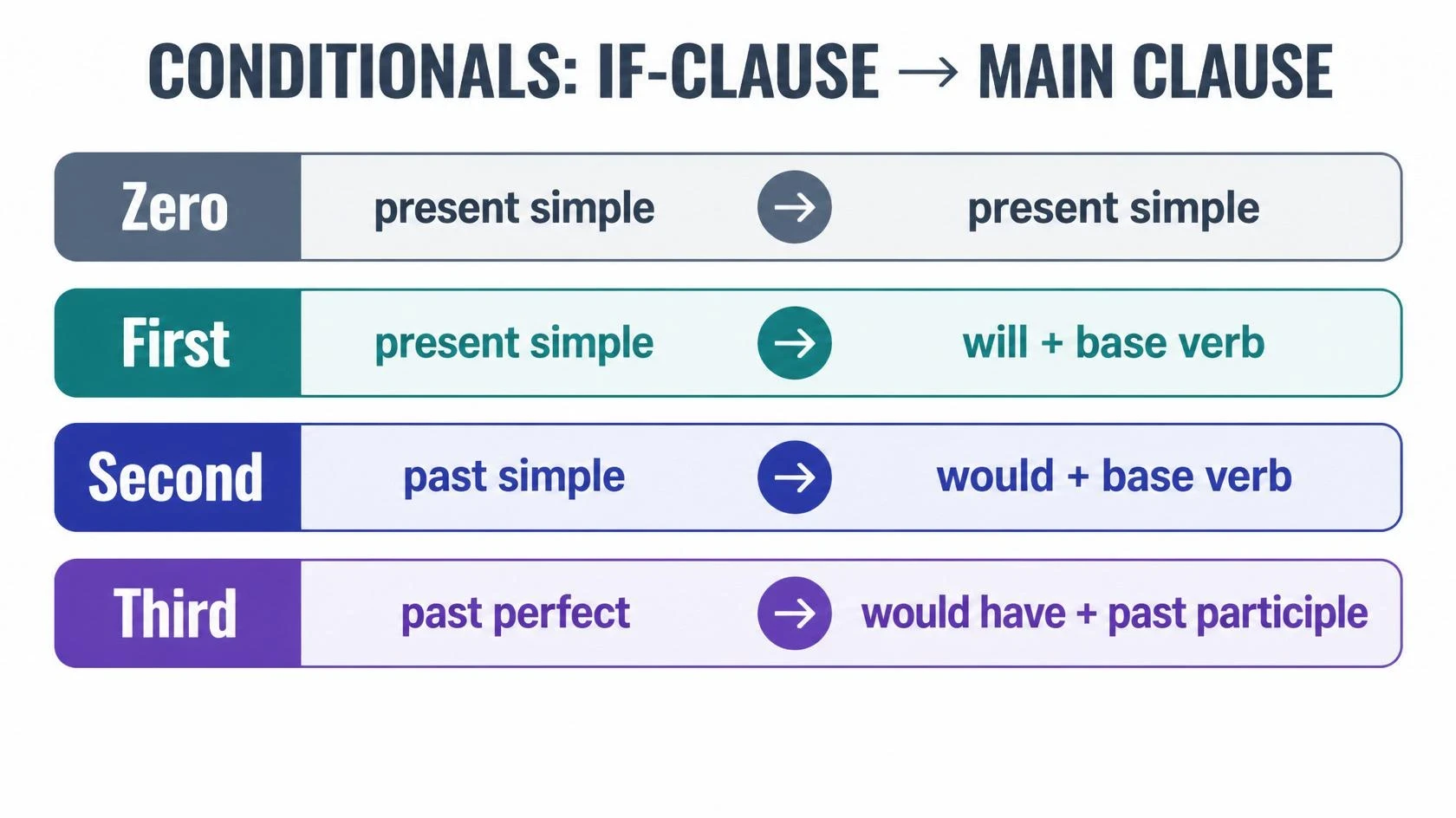
Zero Conditional — General Truths
If + present simple, + present simple. Used for facts and things that are always true.
First Conditional — Real Future Possibility
If + present simple, + will + base verb. Used for realistic future situations.
Second Conditional — Hypothetical Present or Future
If + past simple, + would + base verb. Used for unlikely or imaginary situations now or in the future.
Third Conditional — Unreal Past
If + past perfect, + would have + past participle. Used for imagining a different past.
Mixed Conditionals — Combining Time Frames
Combine two different time frames — usually an unreal past cause with a present result, or a present condition with a past result.
Mixed conditionals combine time frames
Sometimes the if-clause and the result are in different time frames — for example, an unreal past cause with a present result: "If I had studied medicine, I would be a doctor now." These mixed forms are advanced but common in both spoken and written English.
'If I were' is standard, not just formal
In the second conditional, were is traditionally used for all subjects, including I/he/she/it — especially in the phrase "if I were you." "If I was" is common in casual speech, but many style guides still prefer were.
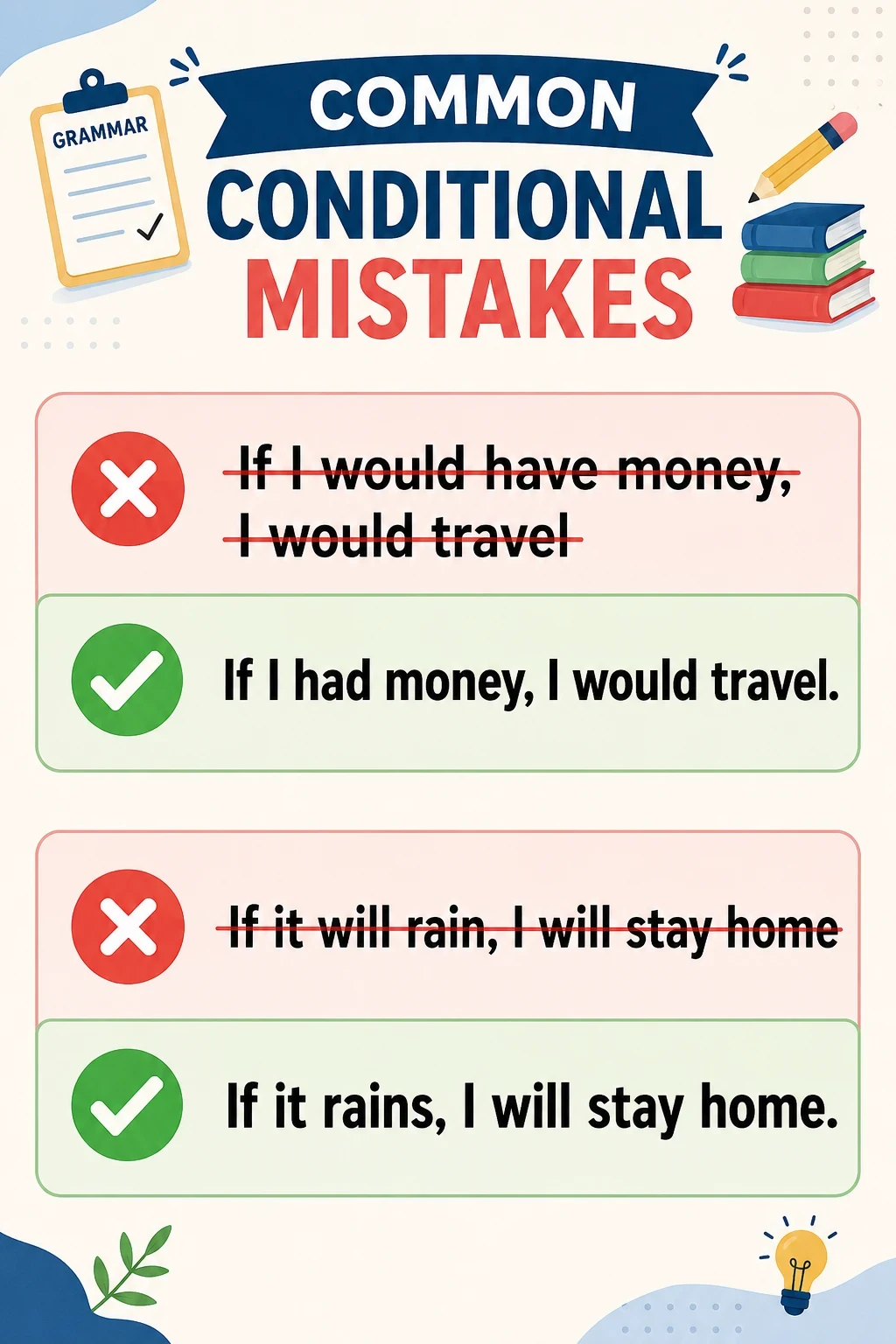
If I would have money, I would travel.
If I had money, I would travel.
Don't use would in the if-clause of a second conditional — the if-clause takes the past simple, and would only appears in the result.
If it will rain, I will stay home.
If it rains, I will stay home.
Don't use will in the if-clause of a first conditional — the if-clause takes the present simple, and will only appears in the result.
If I have known, I would have come.
If I had known, I would have come.
The third conditional's if-clause needs the past perfect (had + past participle), not the present perfect.
If you heated ice, it melts.
If you heat ice, it melts.
The zero conditional uses the present simple in both clauses — don't mix in a past tense for a general truth.
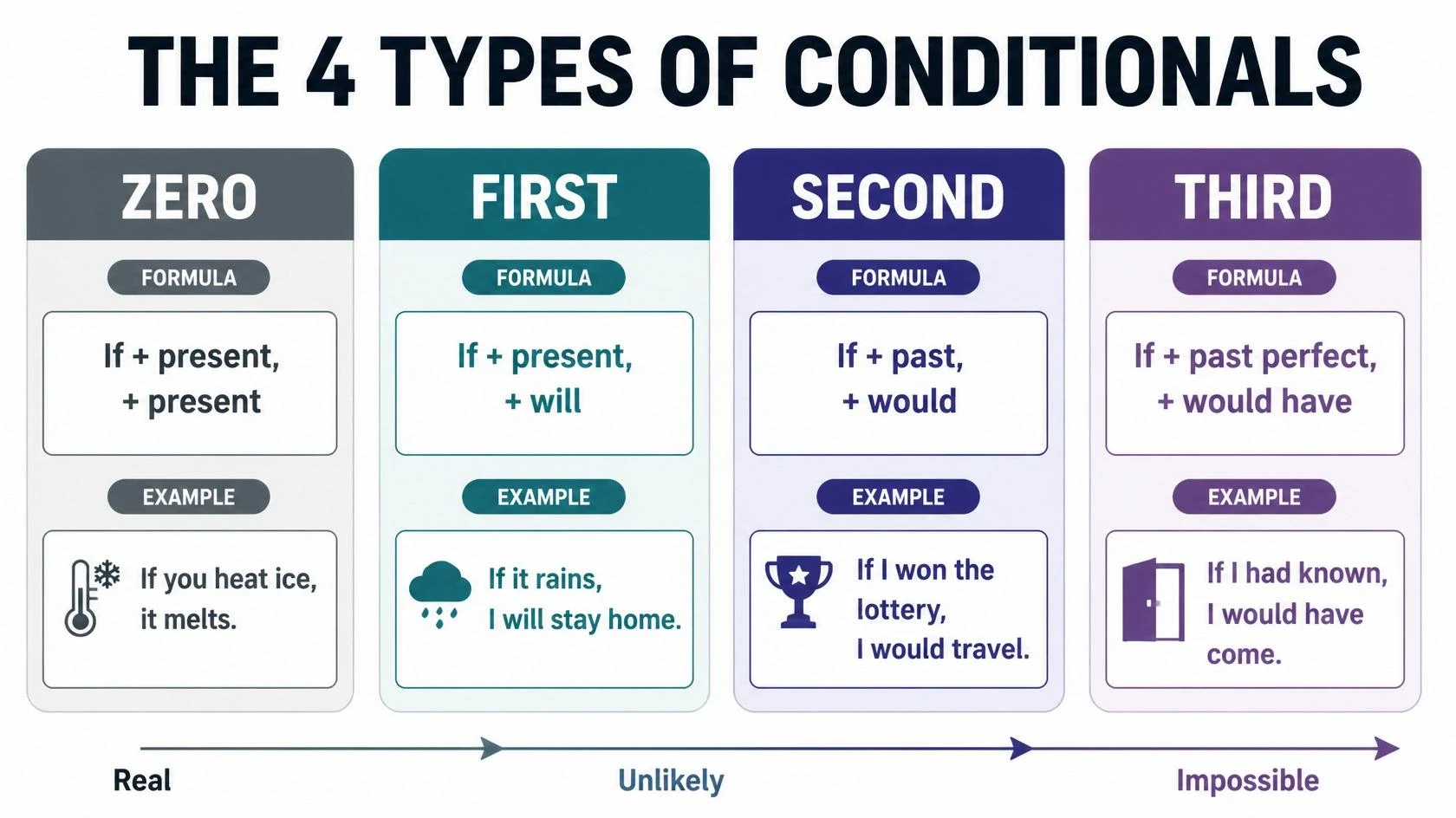
How the if-clause and main-clause tenses map to each type, from real to imaginary.
| Feature | Zero | First | Second | Third |
|---|---|---|---|---|
| If-clause tense | Present simple | Present simple | Past simple | Past perfect |
| Main-clause form | Present simple | will + base verb | would + base verb | would have + past participle |
| Meaning | General truth | Real future possibility | Hypothetical present or future | Unreal past |
| Example | If you heat ice, it melts. | If it rains, I will stay home. | If I won the lottery, I would travel. | If I had known, I would have come. |
Conditionals describe an "if" situation and its result. Use zero for facts, first for realistic futures, second for unlikely or imaginary present/future situations, and third for imagining a different past. The combination of tenses in the if-clause and the main clause determines the type of conditional and its meaning — including mixed conditionals, which pair tenses from two different types in one sentence.
Further reading: Cambridge Dictionary — Conditionals
Look at the verb tense in the if-clause: present simple means zero or first, past simple means second, past perfect means third. Then check how real or likely the situation is.
Not in a standard first conditional — the if-clause uses the present simple (If it rains...), and will only appears in the main clause (...I will stay home).
Second conditional imagines an unreal present or future situation (If I won the lottery, I would travel). Third conditional imagines a different past that already happened and can't change (If I had won the lottery, I would have traveled).
Both are used in practice. "If I were" is the traditional, more formal form (the subjunctive) and is expected in writing and exams. "If I was" is common in casual speech.
Mixed conditionals combine two different time frames in one sentence, like an unreal past cause with a present result: "If I had studied medicine, I would be a doctor now."
No — unless, as long as, provided that, and in case can all introduce a conditional clause instead of if, though if is by far the most common.
Express general truths, scientific facts, and automatic results using if/when + present simple in both clauses.
Use 'unless' and 'if … not' in conditional sentences to express exceptions, warnings, and negative conditions.
Express real, possible future situations using if + present simple and will + infinitive.
Describe imaginary or unlikely situations using if + past simple and would + infinitive.
Combine if-clauses from different time frames — past conditions with present results.
Explore advanced and inverted uses of the second conditional structure.
Deepen understanding of the third conditional and its hypothetical past uses.
Learn unless, provided that, as long as, supposing, and other conditional forms.
Use inverted conditional structures — were it not, had it not been, should you need — in formal English.
Master complex conditional structures including wish, if only, and imagined past/present scenarios.
Use the full range of conditional patterns including literary, formal, and implicit conditionals.