Routines and Habits
Actions you do regularly or repeatedly.
- — She works every day.
- — I go to the gym on Mondays.
- — He always arrives on time.
Master the simple present for habits, routines, facts, schedules, states, negatives, questions, and short answers.
Instant score after exercises · Full answer review · Learn by doing
Grammar Explanation · Authentic Examples · Practice Questions
The present simple is the tense of routines, facts, and things that are generally true. You'll use it to talk about daily habits, scientific facts, fixed schedules, and permanent states — anything that isn't simply happening right now. This lesson breaks down exactly how to form it, when to use it instead of the present continuous, and the mistakes that trip up even confident learners.
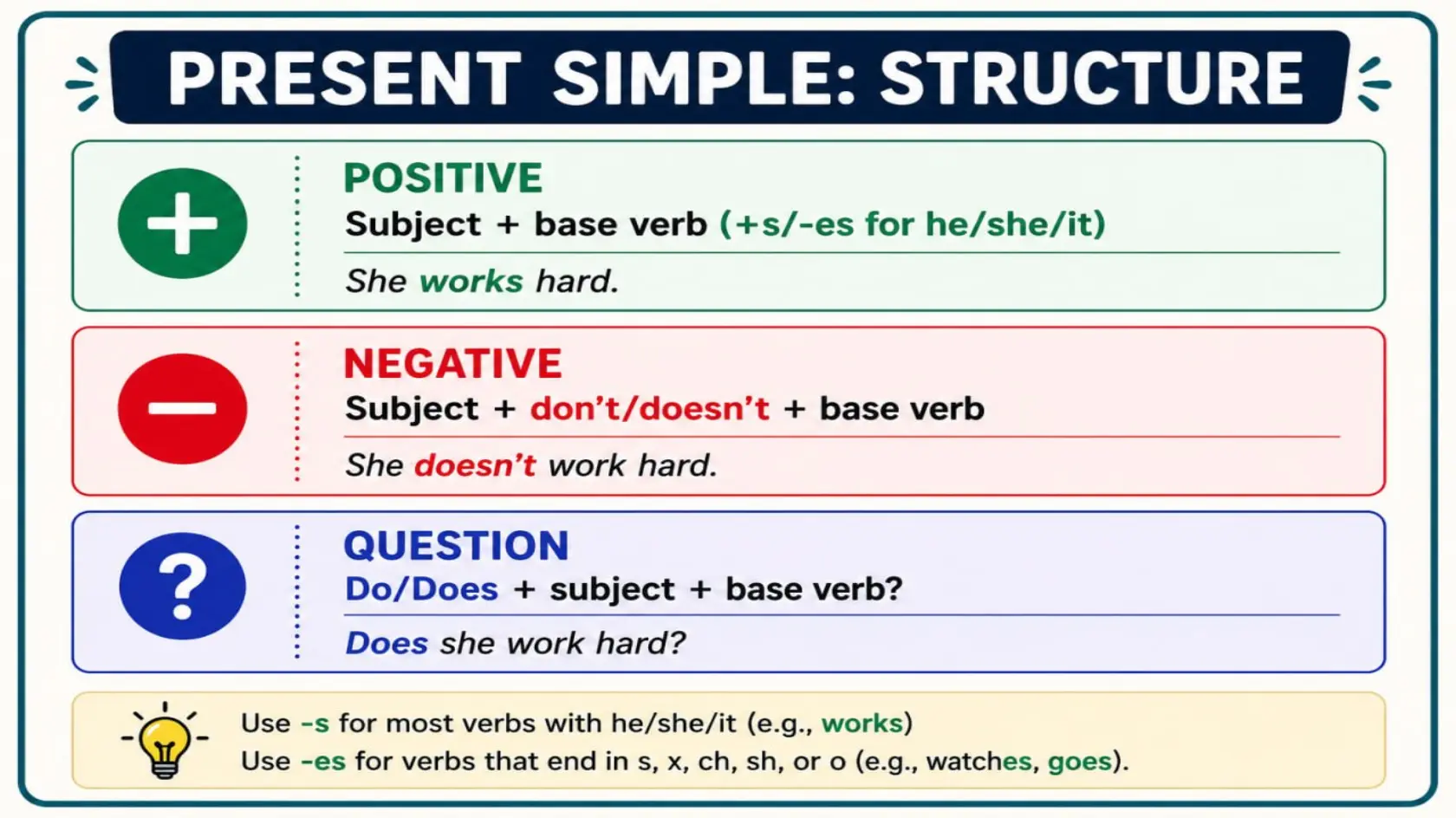
Subject + base verb (+ -s/-es for he/she/it)
Subject + don't/doesn't + base verb
Do/Does + subject + base verb?
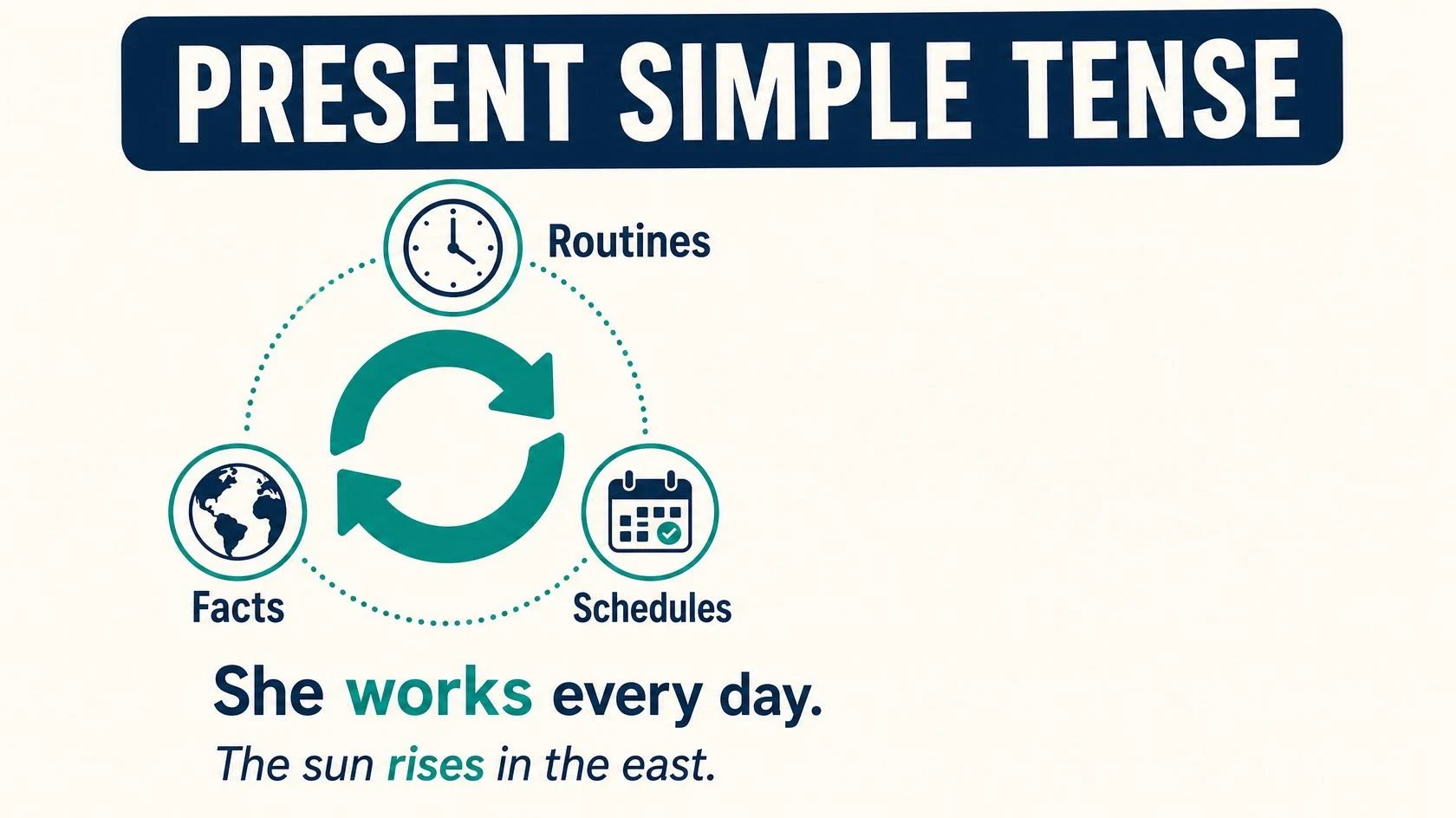
Routines and Habits
Actions you do regularly or repeatedly.
Facts and General Truths
Things that are permanently or generally true.
Schedules and Timetables
Fixed events, especially timetables — even future ones.
Feelings and States
Opinions, emotions, and states that don't naturally take a continuous form.
Stative verbs don't usually take -ing
Verbs like like, believe, know, want, and own describe states, not actions — they stay in the present simple even when talking about now: "I like coffee" (not "I am liking coffee").
Spelling changes for third-person -s
Verbs ending in -s, -ss, -sh, -ch, -x, or -o add -es (watches, passes, goes); verbs ending in a consonant + y change y to -ies (study → studies).
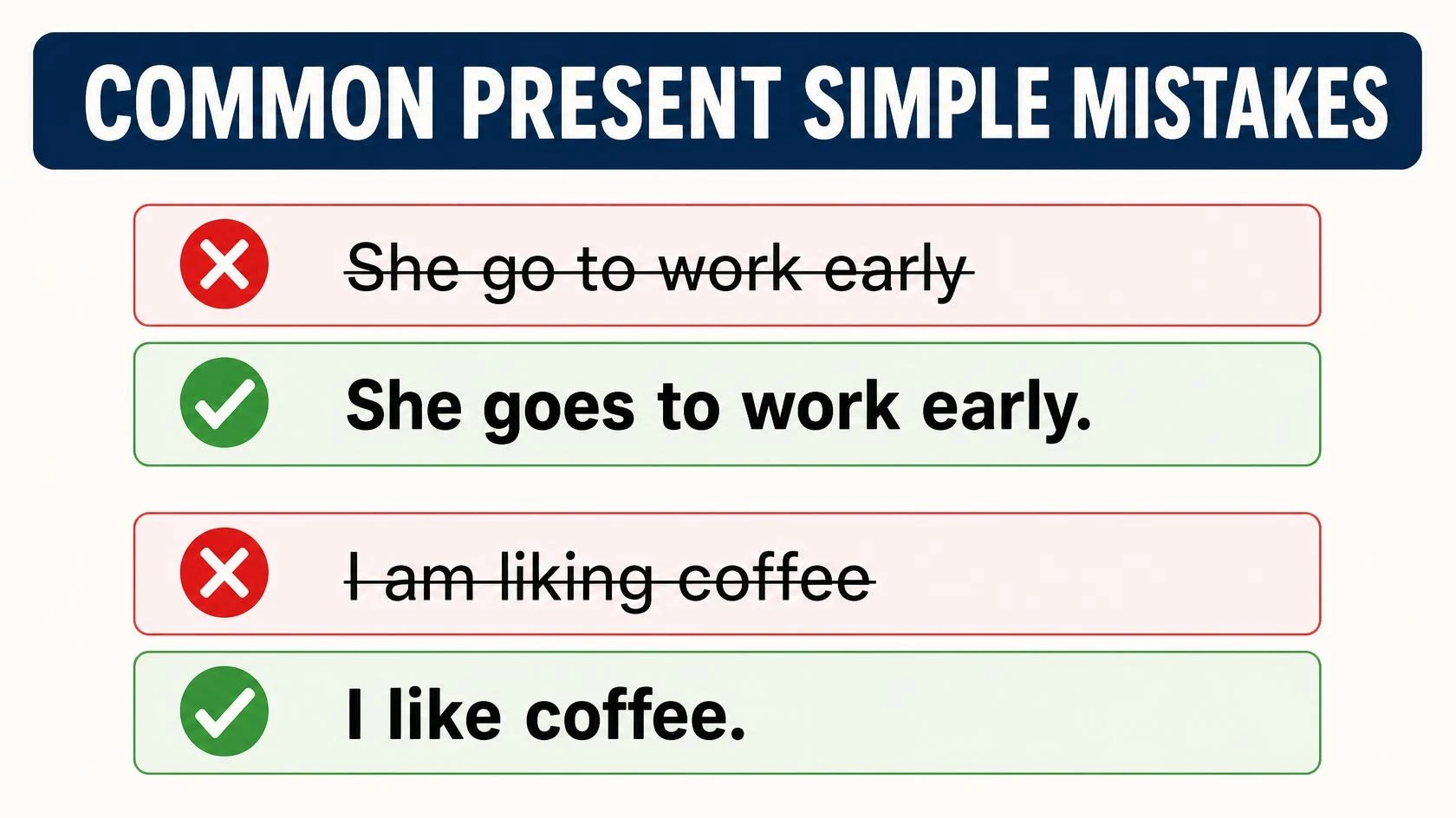
She go to work early.
She goes to work early.
Third-person singular subjects (he, she, it) always need -s (or -es) on the verb in the positive present simple.
I am liking coffee.
I like coffee.
Like is a stative verb — it describes a state, not an action in progress, so it doesn't take the continuous (-ing) form.
Does she works here?
Does she work here?
Once do/does appears in a question, the main verb goes back to its base form — don't add -s twice.
He don't like tea.
He doesn't like tea.
He/she/it needs doesn't, not don't, in the negative present simple.
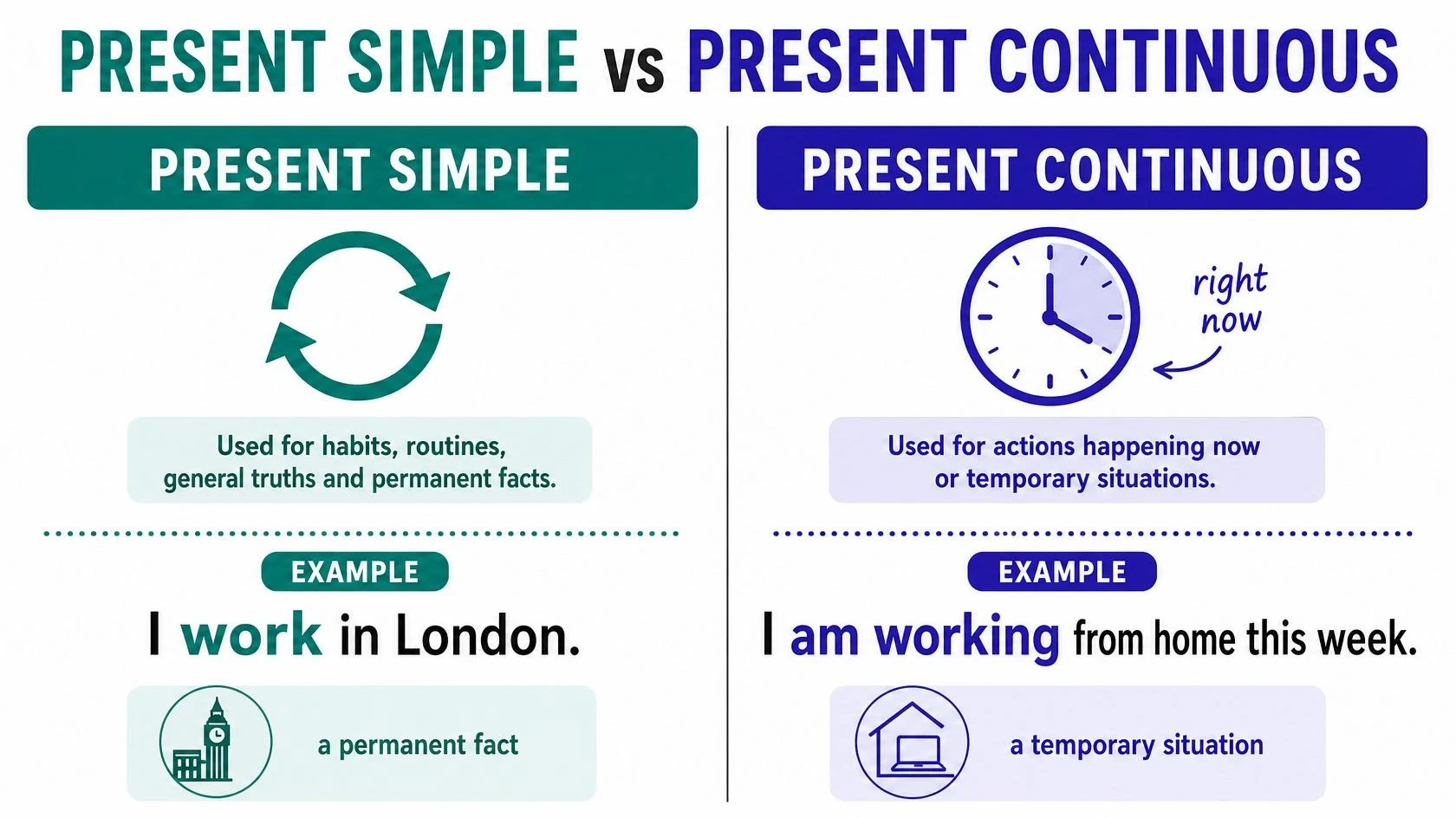
The key question: is it a permanent habit or fact, or something happening right now (or temporarily)?
| Feature | Present Simple | Present Continuous |
|---|---|---|
| Time reference | Habits, routines, permanent facts | Right now, or a temporary situation |
| Typical time words | always, usually, every day, on Mondays | now, right now, at the moment, these days |
| Verb form | base verb (+s for he/she/it) | am/is/are + verb-ing |
| Common use | Routines, facts, schedules | Actions in progress, temporary situations, changing trends |
Use the base verb (+s for he/she/it) for routines, facts, and schedules. Reach for time words like always, usually, and every day — and switch to the present continuous the moment you're describing something happening right now or only temporarily.
Further reading: Cambridge Dictionary — Present simple tense
Present simple describes habits, routines, and permanent facts (I work in London). Present continuous describes what's happening right now or a temporary situation (I am working from home this week).
Stative verbs — like, know, believe, want, own, understand — describe states rather than actions, so they stay in the present simple even when talking about now: "I understand" (not "I am understanding").
Yes — present simple questions with any main verb (not be) use do/does before the subject, unless another auxiliary is already there: use do with I/you/we/they and does with he/she/it. "Do you work here?" / "Does she work here?"
Add -es after verbs ending in -s, -ss, -sh, -ch, -x, or -o: watches, passes, goes. Otherwise, just add -s.
Yes — for fixed schedules and timetables: "The train leaves at 9am tomorrow." This is different from personal plans, which usually use the present continuous or going to.
Yes, the core rules are identical in both varieties. Usage differences between English varieties show up much more in tenses like the present perfect than in the present simple.
Follow the CEFR progression for this topic cluster.
Deepen your grammar knowledge with these related A1 topics.
Use am/is/are + -ing for actions happening now, temporary situations, future plans, and changing trends.
Learn how to build correct simple sentences using a subject and verb — the essential foundation of English grammar.
Master the correct order of subjects, verbs, objects, and adverbials in English sentences — the key to natural, grammatical writing.
Learn how to use 'there is' and 'there are' to describe the existence of people, animals, and things in English.
Ready for the next step? These lessons build on what you've learned.
Master regular and irregular past forms for completed actions, narratives, and time-specific events.
Consolidate and contrast the present simple and past simple tenses through focused review questions.
Use 'will' to make predictions, decisions, promises, and offers about the future — one of the most important future structures in English.
Use was/were + -ing to describe ongoing past actions, background settings, and simultaneous past events.
Use 'be going to' for intentions, plans already decided, and predictions based on present evidence.
Use the present continuous (am/is/are + -ing) to talk about fixed arrangements and plans in the near future.
Express future meaning using 'will', 'be going to', the present continuous for plans, and predictions in English.
Use the present simple to talk about scheduled or timetabled future events — trains, flights, events with fixed times.
Connect past experience to the present using have/has + past participle with ever, never, just, already, and yet.