Regular Nouns — Singular or Plural
The basic rule: a singular subject takes a verb with -s, a plural subject takes a verb without -s.
- — She runs fast.
- — They run fast.
Grammar Rules
Learn the rules for matching subjects and verbs correctly in all sentence types.
Subject-Verb Agreement on Grammartier spans A1–B1 levels, with 5 interactive lessons including Basic Subject-Verb Agreement, Collective Nouns Agreement and Indefinite Pronouns Agreement — each with clear explanations, real examples, and a quiz you can score instantly.
Subject-verb agreement means the verb must match its subject in number — singular subjects take a singular verb, plural subjects take a plural verb. Most of the time this is automatic, but collective nouns, indefinite pronouns, and either/or constructions trip up even confident learners. This page covers every real-world case, from the basic rule to the tricky exceptions.
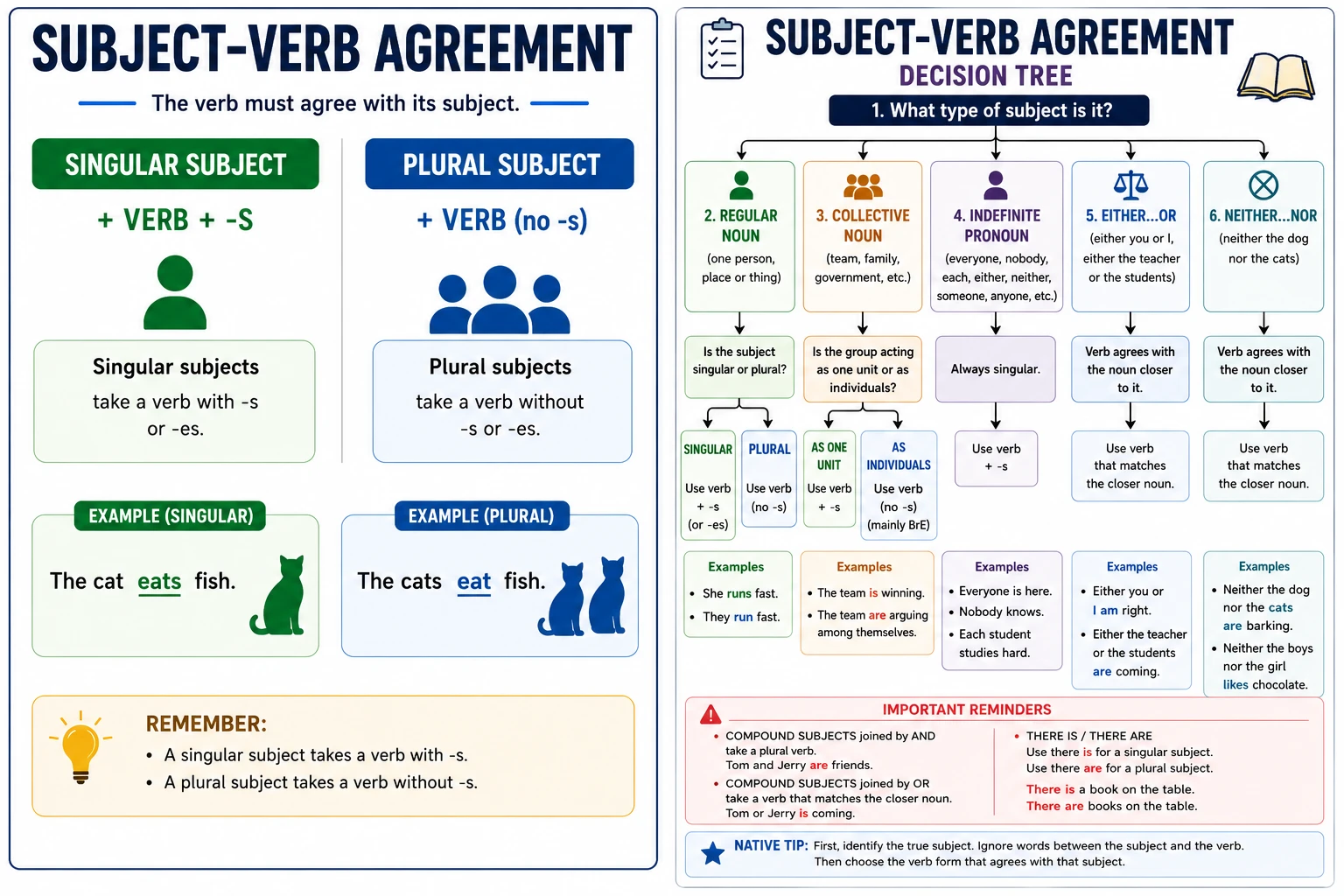
Singular subject + base verb + -s/-es / Plural subject + base verb (no -s)
Singular subject + doesn't + base verb / Plural subject + don't + base verb
Does + singular subject + base verb? / Do + plural subject + base verb?
Regular Nouns — Singular or Plural
The basic rule: a singular subject takes a verb with -s, a plural subject takes a verb without -s.
Collective Nouns
Collective nouns (team, family, government) take a singular verb when acting as one unit, and a plural verb when members act as individuals — especially in British English. American English usually prefers the singular either way.
Indefinite Pronouns
Everyone, nobody, each, either, someone, and anyone are always singular, even though they can feel plural in meaning.
Either...Or / Neither...Nor
With either/or and neither/nor, the verb agrees with the noun closer to it — not the first noun.
There is / There are
Use there is for a singular subject and there are for a plural subject: There is a book on the table. There are books on the table.
Subjects joined by and vs or
Subjects joined by and take a plural verb: Tom and Jerry are friends. Subjects joined by or take a verb that matches the closer noun: Tom or Jerry is coming.
The team are winning by ten points.
The team is winning by ten points.
When a collective noun acts as one unit, use a singular verb. Use a plural verb only when you mean the individual members acting separately.
Everyone are here.
Everyone is here.
Indefinite pronouns like everyone, nobody, and each are always singular, no matter how plural they feel in meaning.
Neither the dog nor the cats is barking.
Neither the dog nor the cats are barking.
With neither...nor, the verb agrees with the noun closer to it. Cats (plural) is closer to the verb, so it must be are, not is.
There is a book and a pen on the table.
There are a book and a pen on the table.
With a compound subject joined by and, use there are — the combined subject is plural even though the first noun (book) is singular.
Six common subject types and how the verb agrees with each one.
| Feature | Subject type | Verb agreement | Example |
|---|---|---|---|
| Regular singular | Singular verb (+ -s/-es) | She runs fast. | |
| Regular plural | Plural verb (no -s) | They run fast. | |
| Collective noun (as one unit) | Singular verb | The team is winning. | |
| Collective noun (as individuals) | Plural verb | The team are arguing among themselves. | |
| Indefinite pronoun | Singular verb (always) | Everyone is here. | |
| Either/or, neither/nor | Matches the closer noun | Neither the dog nor the cats are barking. |
The verb must agree in number with its subject: singular subjects take a singular verb, plural subjects take a plural verb. Collective nouns can be singular or plural depending on whether the group acts as one unit or as individuals. Indefinite pronouns (everyone, nobody, each) are always singular. With either/or and neither/nor, the verb agrees with the noun closer to it.
Further reading: Cambridge Dictionary — Subject-verb agreement, Purdue OWL — Subject-Verb Agreement
It's the rule that a verb must match its subject in number — singular subjects take a singular verb form, plural subjects take a plural verb form. The cat eats fish (singular), The cats eat fish (plural).
It depends on meaning. Use a singular verb when the team acts as one unit (The team is winning), and a plural verb (mainly in British English) when members act as individuals (The team are arguing among themselves).
Always singular, even though they can refer to many people. Everyone is here, not Everyone are here. The same applies to nobody, each, someone, and anyone.
The verb agrees with the noun closest to it, not the first noun. Either the teacher or the students are coming (students is closer, so plural). Either you or I am right (I is closer, so am).
Yes — subjects joined by and are treated as plural: Tom and Jerry are friends. Subjects joined by or take a verb matching the closer noun: Tom or Jerry is coming.
Learn the foundational rules for matching singular and plural subjects with the correct present tense verb form.
Decide whether collective nouns — team, family, government, group — take singular or plural verbs in context.
Use everyone, nobody, something, each, either, and neither with singular or plural verbs following the rules.
Master either/or and neither/nor agreement — when to use singular or plural verbs in complex sentence patterns.
Handle subject-verb agreement in sentences with inverted order, relative clauses, and intervening phrases.