Sequencing Past Events
Showing which of two past actions happened first.
- — The train had left before I arrived at the station.
- — She had already eaten when I got home.
- — By the time we arrived, the movie had started.
Use had + past participle to describe an action completed before another past action — the tense that goes one step further back in time.
Instant score after exercises · Full answer review · Learn by doing
Grammar Explanation · Authentic Examples · Practice Questions
The past perfect shows that one thing happened before another point in the past. It's the tense that puts past events in the right order — which action came first, and which came after. This lesson breaks down exactly how to form it, when you actually need it, and the mistakes that trip up even confident learners.
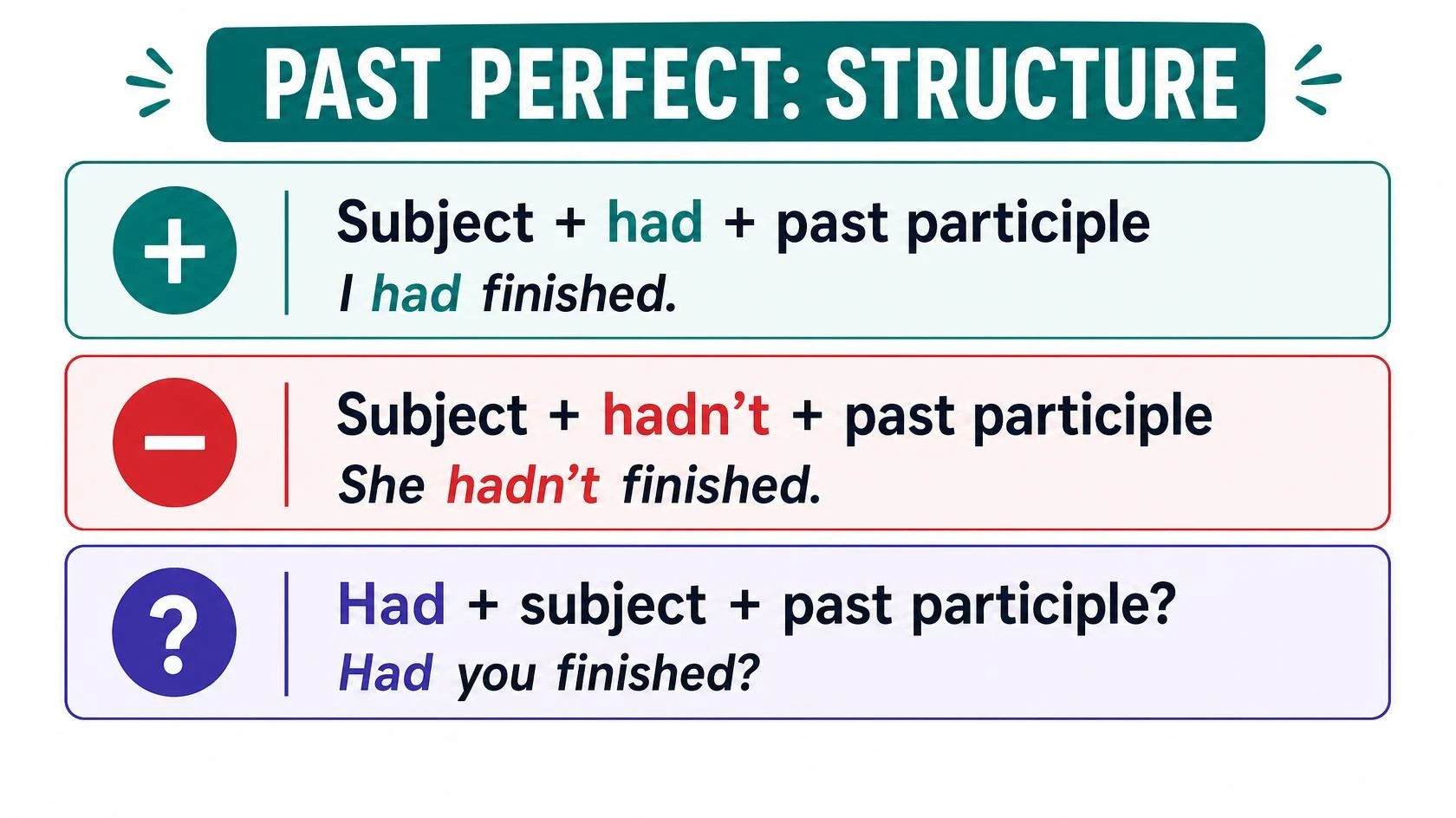
Subject + had + past participle
Subject + hadn't + past participle
Had + subject + past participle?
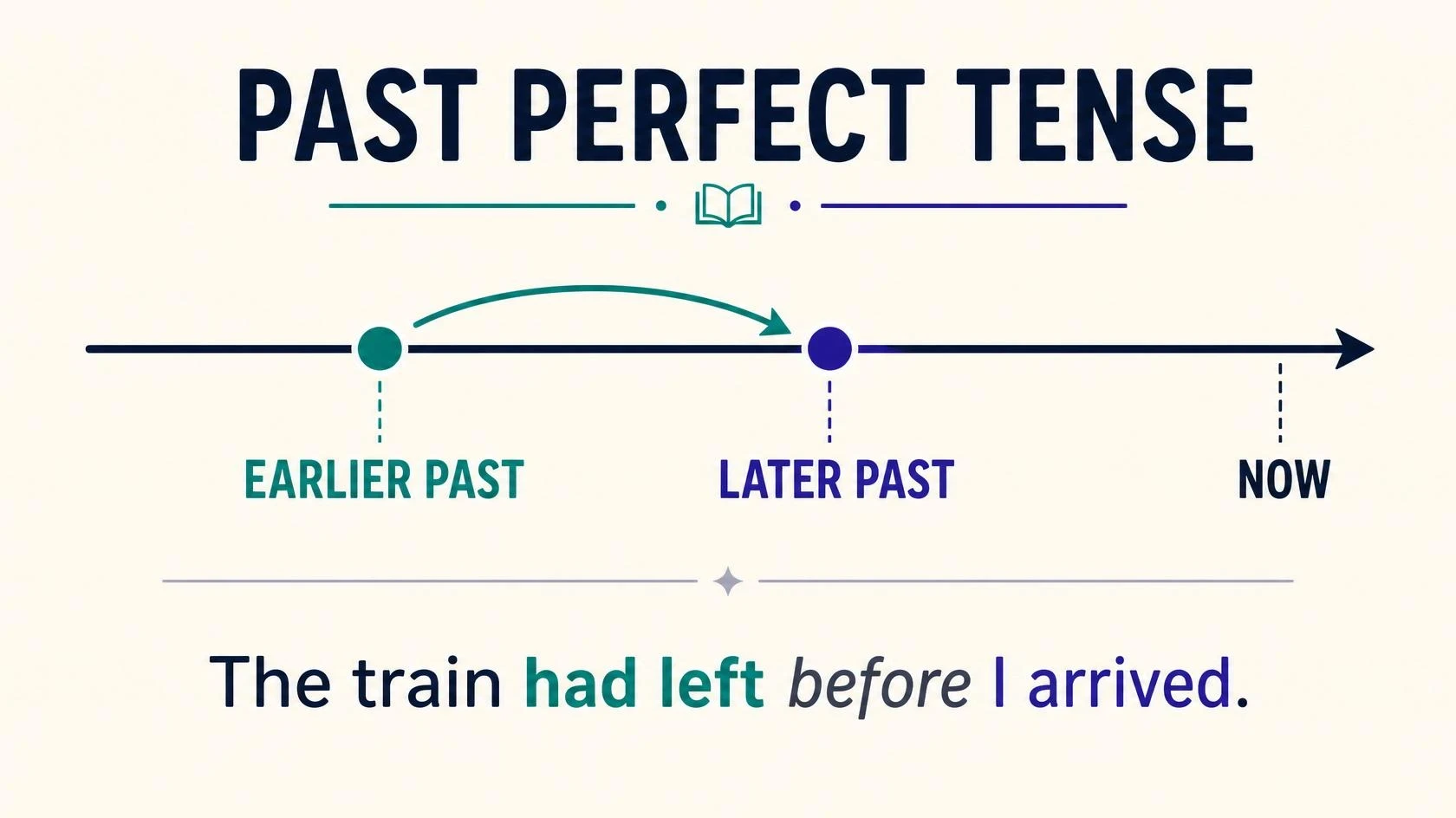
One action happened before another point in the past — the past perfect marks which one came first.
Example: The train had left before I arrived. (Leaving happened first.)
Sequencing Past Events
Showing which of two past actions happened first.
Reported Speech
Reporting what someone said or thought about an earlier past event.
Cause and Result in the Past
Explaining why something happened, based on an earlier event.
Unfulfilled Hopes or Plans
Describing something that was hoped for or planned but didn't happen.
Don't use it for a single past event
If you're only talking about one past action, use the past simple, not the past perfect: "I ate breakfast" (not "I had eaten breakfast") — unless you're showing that it happened before another past event.
Irregular past participles must be memorised
Same irregular forms as the present perfect: go → gone, see → seen, do → done, write → written.
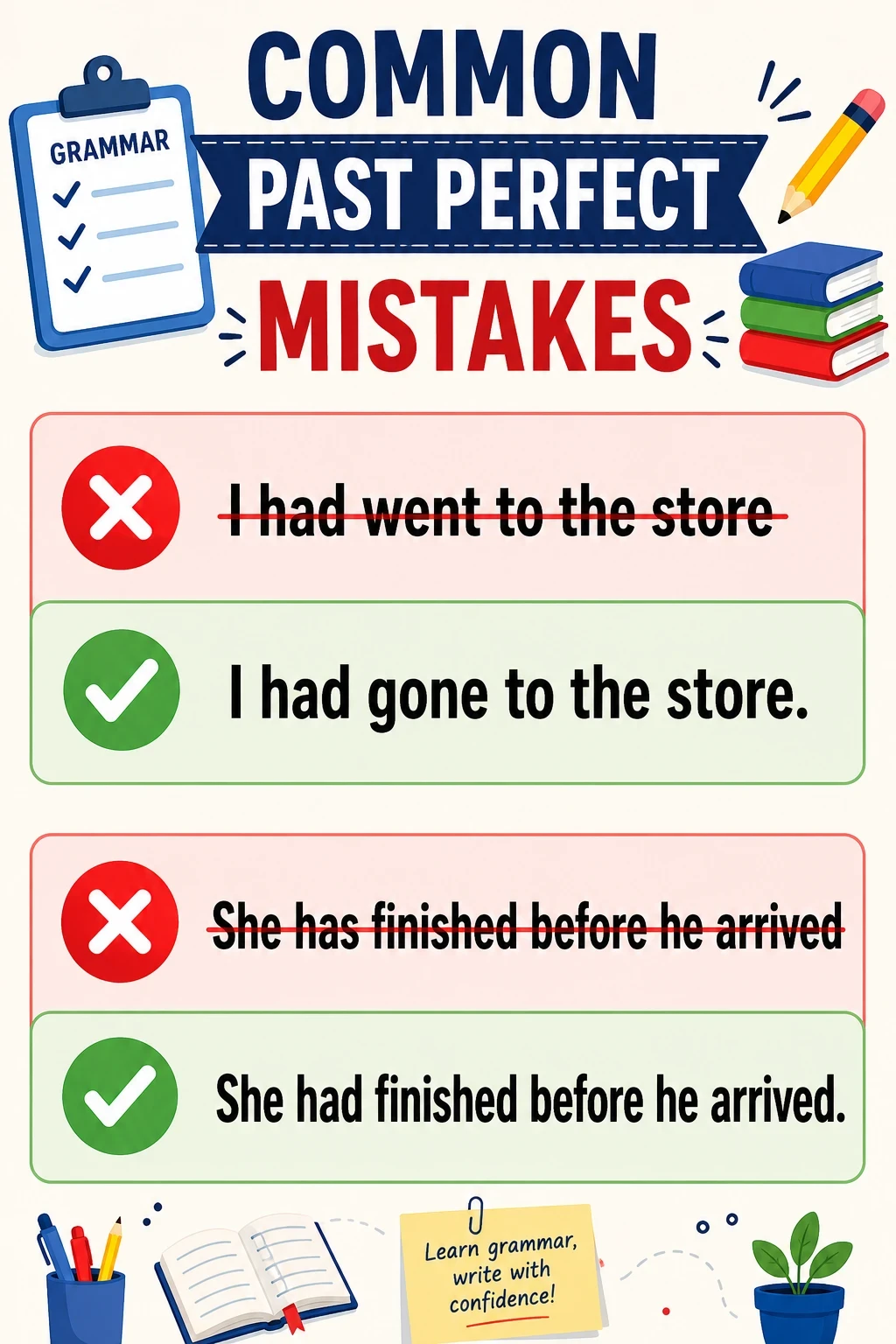
I had went to the store.
I had gone to the store.
"Went" is the past simple form. The past perfect always needs the past participle: go → gone.
She has finished before he arrived.
She had finished before he arrived.
When comparing two past events, use had (past perfect), not has (present perfect).
I had ate dinner when you called.
I had eaten dinner when you called.
"Ate" is the past simple form of eat. The past participle is eaten.
By the time I arrived, the film already started.
By the time I arrived, the film had already started.
"By the time" plus a later past action signals that the earlier action needs the past perfect.
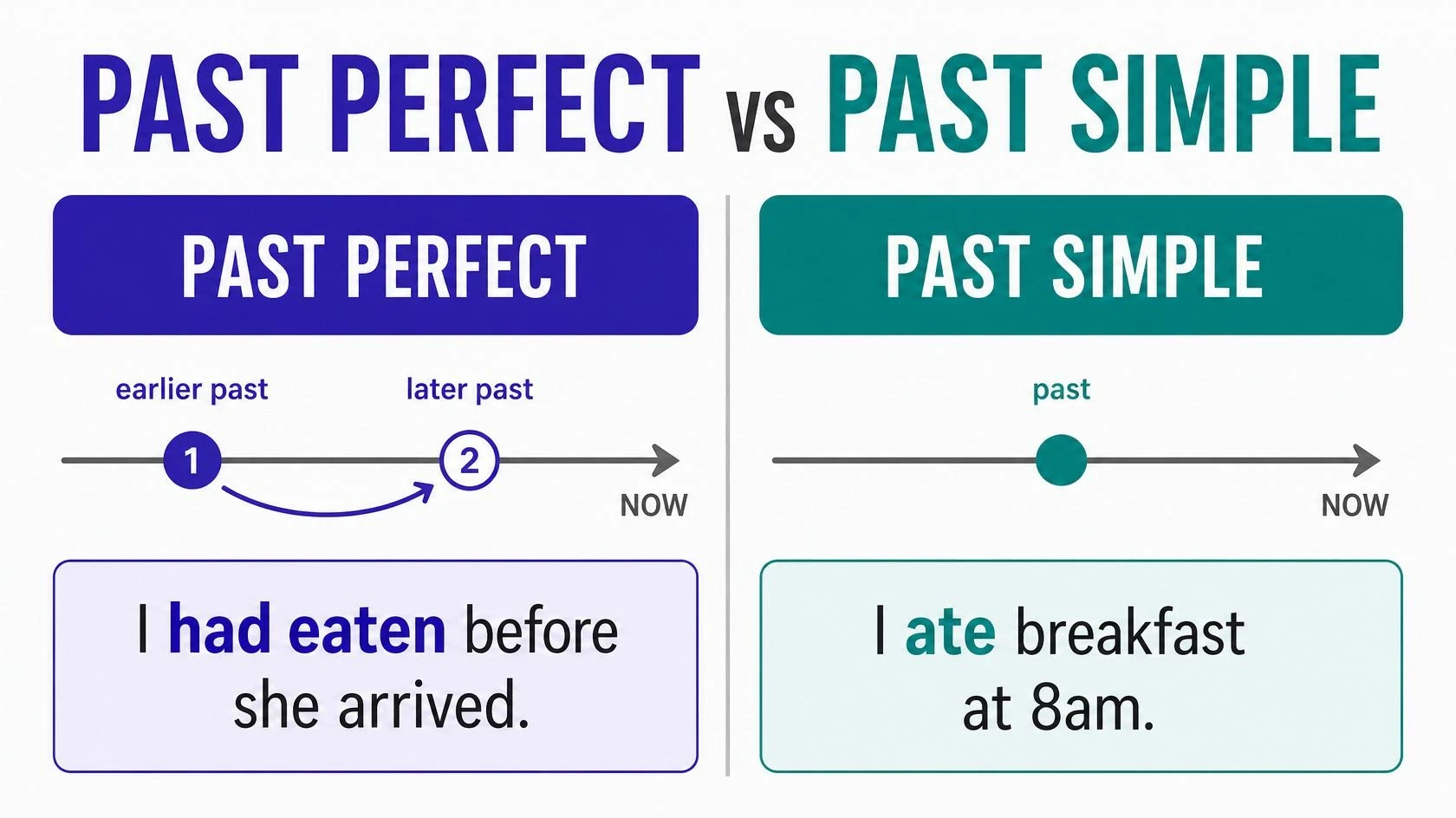
The key question: are you comparing two past events, or just describing one?
| Feature | Past Perfect | Past Simple |
|---|---|---|
| Purpose | Marks an earlier action as happening before another past reference point | Describes completed past actions — sequence can be shown by word order alone |
| Time reference | Before another past point | At a specific finished time |
| Typical time words | before, after, already, just, by the time | yesterday, last week, in 2020, ago |
| Common use | Sequencing past events, reported speech | Completed actions, stories, sequences of events |
Use had + past participle to show one past action happened before another. Reach for the past perfect with before, after, already, just, and by the time when you're sequencing two past events — and stick with the past simple when you're only describing one.
Further reading: Cambridge Dictionary — Past perfect tense
Past perfect shows one past action happened before another past action (I had eaten before she arrived). Past simple describes a single completed action (I ate breakfast).
No — only when the order matters and isn't already clear. If you use before or after, the order is often already obvious, so many native speakers use the past simple for both: "I left after I finished" is fine in casual speech.
Yes — unlike the present perfect (have/has), the past perfect uses had for every subject: I had, you had, she had, they had.
"Went" is the simple past form (I went to the store). "Had gone" is the past perfect, used when that trip happened before another past event (I had gone to the store before you called).
Yes — when reporting what someone said, a past simple statement often shifts back to the past perfect: "I finished" becomes "She said she had finished."
Yes, the rules are the same in both. The main difference is that casual speech in both varieties often drops the past perfect when the sequence of events is already clear from context.
Follow the CEFR progression for this topic cluster.
Make sure you're comfortable with these topics first.
Master regular and irregular past forms for completed actions, narratives, and time-specific events.
Use was/were + -ing to describe ongoing past actions, background settings, and simultaneous past events.
Consolidate and contrast the present simple and past simple tenses through focused review questions.
Master the simple present for habits, routines, facts, schedules, states, negatives, questions, and short answers.
Deepen your grammar knowledge with these related B1 topics.
Connect past experience to the present using have/has + past participle with ever, never, just, already, and yet.
Review all conditional tense forms — zero, first, second, third, and mixed — focusing on the verb patterns in each conditional type.
Describe actions that started in the past and are still continuing, or have recently stopped, using have/has been + -ing.
Use 'would + infinitive' to describe repeated past habits and routines — similar to 'used to' but only for actions, not states.
Ready for the next step? These lessons build on what you've learned.
Describe actions in progress before a past point using the past perfect continuous.
Express actions that will be completed before a specific future point.
Use 'would' and 'was/were going to' to describe something that was expected or planned in the past but relates to a future time from that past point.
Understand how tenses change in complex sentences, reported speech, and conditional clauses to maintain logical time relationships.
Use am/is/are + -ing for actions happening now, temporary situations, future plans, and changing trends.
Use 'will' to make predictions, decisions, promises, and offers about the future — one of the most important future structures in English.
Use 'be going to' for intentions, plans already decided, and predictions based on present evidence.
Use the present continuous (am/is/are + -ing) to talk about fixed arrangements and plans in the near future.
Express future meaning using 'will', 'be going to', the present continuous for plans, and predictions in English.