Defining (Restrictive) Clauses
Give essential information, no commas. If you remove the clause, the meaning changes or is incomplete.
- — The man who lives next door is a doctor.
- — The book that I borrowed was very interesting.
Use who, which, that, whose, where, and when to add information about people, things, and places.
Instant score after exercises · Full answer review · Learn by doing
Grammar Explanation · Authentic Examples · Practice Questions
Relative clauses add extra information about a noun using words like who, which, that, whose, where, and when. Defining clauses give essential information with no commas; non-defining clauses give extra information set off by commas. This lesson breaks down exactly how to form and use each type, plus the mistakes that trip up even confident learners.
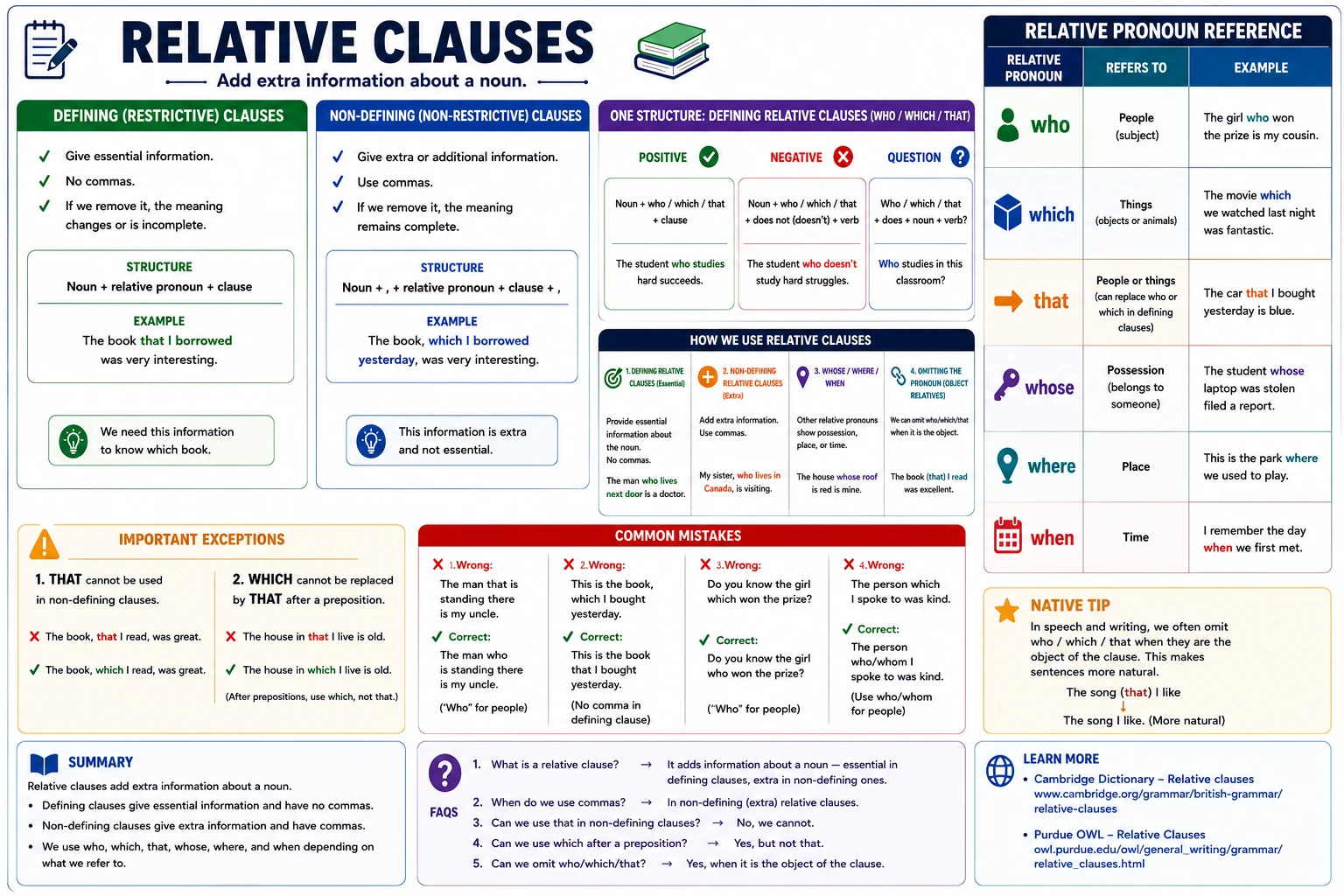
Noun + who/which/that + clause
Noun + who/which/that + does not (doesn't) + verb
Who/which/that + does + noun + verb?
Defining (Restrictive) Clauses
Give essential information, no commas. If you remove the clause, the meaning changes or is incomplete.
Non-Defining (Non-Restrictive) Clauses
Give extra, non-essential information, always with commas. If you remove the clause, the meaning remains complete.
Whose, Where, When
Other relative pronouns show possession (whose), place (where), or time (when).
Omitting the Pronoun (Object Relatives)
You can omit who, which, or that when it is the object of the clause — common in speech and informal writing.
That cannot be used in non-defining clauses
In a non-defining clause, use which or who — never that. The book, that I read, was great is wrong; The book, which I read, was great is correct.
Which cannot be replaced by that after a preposition
After a preposition, use which, not that. The house in that I live is old is wrong; The house in which I live is old is correct.
The man that is standing there is my uncle.
The man who is standing there is my uncle.
Use who for people rather than that, especially in more formal or careful writing.
This is the book, which I bought yesterday.
This is the book that I bought yesterday.
This is a defining clause (it identifies which book) — no comma, and that or which both work, but a comma before a defining clause is wrong.
Do you know the girl which won the prize?
Do you know the girl who won the prize?
Which cannot refer to people — use who instead.
The person which I spoke to was kind.
The person who/whom I spoke to was kind.
Which is only for things, never for people — use who or whom.
Six relative pronouns and what each one refers to.
| Feature | Relative pronoun | Refers to | Example |
|---|---|---|---|
| who | People (subject) | The girl who won the prize is my cousin. | |
| which | Things (objects or animals) | The movie which we watched last night was fantastic. | |
| that | People or things (defining clauses only) | The car that I bought yesterday is blue. | |
| whose | Possession | The student whose laptop was stolen filed a report. | |
| where | Place | This is the park where we used to play. | |
| when | Time | I remember the day when we first met. |
Relative clauses add information about a noun — essential information in defining clauses (no commas), extra information in non-defining clauses (with commas). We use who, which, that, whose, where, and when depending on what we're referring to: people, things, possession, place, or time. That cannot be used in non-defining clauses, and which (not that) is required after a preposition.
Further reading: Cambridge Dictionary — Relative clauses, Purdue OWL — Relative Clauses
It adds information about a noun — essential in defining clauses, extra in non-defining ones.
In non-defining (extra) relative clauses.
No, we cannot.
Yes, but not that.
Yes, when it is the object of the clause.
Follow the CEFR progression for this topic cluster.
Make sure you're comfortable with these topics first.
Use time clauses with 'when', 'while', 'before', 'after', and 'as soon as' to describe sequences and simultaneous actions.
Learn independent and dependent clauses, relative clauses, and clause types in English.
Deepen your grammar knowledge with these related B1 topics.
Use 'that' clauses after verbs of thinking, believing, feeling, and reporting to express ideas and reported speech.
Learn phrasal verbs — verb + particle combinations like give up, look after, and turn on — and how they change meaning in English.
Use 'to' + infinitive to express purpose and reason — explaining why someone does something in English.
Master when to use gerunds (-ing) and infinitives (to + verb) after verbs, adjectives, and prepositions in English.
Ready for the next step? These lessons build on what you've learned.
Master defining and non-defining relative clauses with all relative pronouns.
Reduce relative clauses using present and past participles for concise writing.
Use present and past participle clauses to add information concisely.
Reduce and simplify relative clauses in formal contexts using participles and infinitives.